
Frozen transport
Freezer van and truck rental in Dubai
A freezer vehicle is not a different vehicle — it is the same refrigerated body set to hold −18 °C instead of chilled. We run that setting from a 3-tonne van up to a 10-tonne truck. What matters is which size fits your pallet count, and whether −18 is genuinely cold enough for what you are carrying.
From AED 380 to AED 800 per day
−18 °C to +5 °C
3, 5 and 10 tonne bodies
Driver supplied
The sizes
3-tonne, 5-tonne or 10-tonne frozen
Every one of these holds −18 °C. The choice is volume and pallet count, not temperature. Smaller than this and you are into chilled work rather than frozen.
| Vehicle | Body | Payload | From / day | What it suits |
|---|---|---|---|---|
| 3-Ton Freezer Van | 4.2 m body, 1.9 m high | 3,000 kg | AED 380 | Daily rounds, restaurant and market deliveries, a few pallets of frozen at a time. |
| 5-Tonne Freezer Truck | 5.2 m body, 2.1 m high, approx. 23 m³ | 5,000 kg | AED 500 | Multi-drop frozen distribution, or one bigger cold-store collection. |
| 10-Tonne Freezer Truck | 7.5 m body, 2.4 m high, approx. 43 m³ | 10,000 kg | AED 800 | Full pallet loads and cold store to cold store transfers at one temperature. |
Rates are starting figures and drop on weekly and monthly terms. Full breakdown of what is and is not included is on the rates page.
Weight
Size a frozen load by weight before you size it by space
A freezer body is usually full by weight while there is still floor showing. Working out which limit you reach first takes two numbers: what each pallet weighs, and how many pallet positions the body has.
Divide the payload by the number of pallet positions and you get the average weight each position can carry before the vehicle is over its limit. On the published body sizes that works out at about 500 kg a position on the 3-ton van loaded with euro pallets, 625 kg on the 5-tonne truck, and 714 kg on the 10-tonne truck loaded with industrial pallets. The position counts come from the van and truck dimensions guide. A pallet heavier than that average means the vehicle runs out of payload before it runs out of floor.
Take a frozen load of 700 kg a pallet as an example, counting the product, the wrap and the pallet itself; an empty wooden pallet weighs around 25 kg on its own. The 3-ton van carries four of those pallets, not six. The 5-tonne truck carries seven, with one position left empty. The 10-tonne truck carries fourteen, which fills its industrial positions and its payload at almost exactly the same moment.
Use the weight printed on the supplier’s delivery note or the cold store’s dispatch sheet rather than an estimate from the carton count. If the loaded weight is close to the payload, tell us when you book: an overloaded truck brakes badly, and the fine for overloading lands on the driver.
The unit
Why a freezer unit defrosts, and why the display jumps
A reading that climbs for a few minutes and then falls back is usually the unit doing its job. Knowing why stops a sound load from being written off.
Every time the doors open, warm and humid air gets into the body. At −18 °C the moisture in that air freezes onto the coil inside the refrigeration unit, and a coil coated in ice passes less cold air. So the unit periodically stops cooling and melts the ice away: the defrost cycle. While it runs, the fans pause and the air temperature on the display can rise by several degrees, then recover once cooling restarts.
A frozen pallet does not follow the air. Solid product holds so much cold that a short defrost barely moves its core temperature, which is why the display is the wrong thing to react to during a cycle. The time to worry is a reading that keeps climbing well past the point where a defrost would have finished, or a unit whose sound has changed; the cooling-failure guide linked further down this page covers what to check then.
Door openings are what drive defrosting. A frozen multi-drop round with the shutter up for long stretches forces more cycles and leaves the unit less time to cool. Keep each opening short and close the doors between pallets instead of leaving them open while product is moved, and a long round stays on top of its temperature.
The temperature
What −18 °C covers, and what it does not
Most freezer rental pages stop at the word “frozen”. It is worth being more precise than that, because the gap between −18 and −25 is where claims get made that the vehicle cannot keep.
Yes — standard frozen food
−18 °C is the international benchmark for frozen, and it covers the great majority of what moves: frozen meat and poultry, seafood, frozen vegetables, par-baked and frozen bakery, frozen prepared meals, chips and frozen ready lines. If your supplier stores it at −18, we hold it at −18.
No — true deep freeze
Ice cream is the honest exception. Distribution standards for ice cream sit nearer −25 °C, and some deep-freeze seafood is specified colder still. Our units hold to −18, not below it. If you are moving ice cream to a retail standard, we will tell you we are not the right vehicle rather than take the booking.
The unit holds, it does not pull down
This is the single most common cause of a rejected frozen delivery. A transport unit is built to maintain a temperature, not to freeze a warm load. Product that goes in at −5 will not be at −18 when it arrives, however long the run. Load it already frozen, straight from the cold store.
Frozen and chilled cannot share a body
One body, one setting. If the round has both, the usual answer is to run the vehicle frozen and carry the chilled portion in insulated boxes, or take two vehicles. Guessing a middle temperature ruins both halves of the load.
Ice cream to a retail distribution standard, and deep-freeze seafood specified colder still. Our units hold to −18 °C and do not go below it. If this is what you are moving we will tell you before you book rather than after.
The international benchmark for frozen, and the great majority of what moves: meat and poultry, seafood, frozen vegetables, par-baked and frozen bakery, prepared meals and frozen ready lines. Loaded already frozen, straight from the cold store.
Fresh meat, dairy, produce, cut flowers and pharmaceuticals. The same vehicles do this work. One body holds one setting, though, so it cannot run frozen and chilled on the same trip.
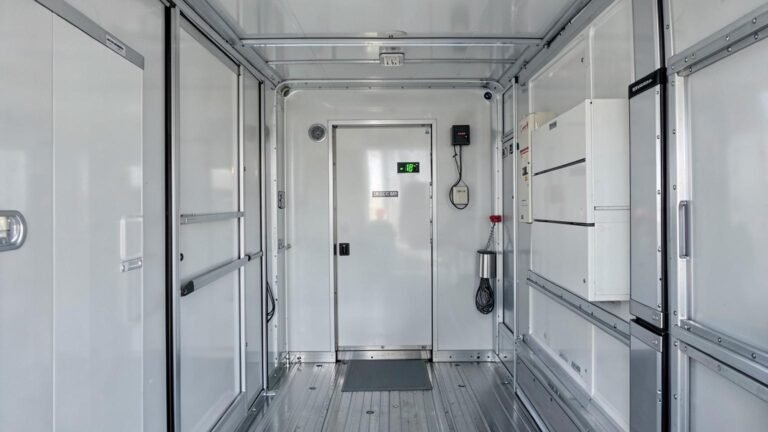
Getting it there frozen
Four things that decide whether it arrives at temperature
None of these are about the vehicle. They are about how it is used, and they are where most frozen loads are actually lost.
Pre-cool the body first
Run the unit down to temperature before the first pallet goes in, not as you pull away. Loading into a warm body puts the whole run on the back foot and costs more diesel than the pre-cool would have.
Door discipline matters more here
In a Dubai summer the difference between the body and the air outside is over sixty degrees. Every minute the shutter is up at a drop is doing far more damage on a frozen load than the same minute would on a chilled one. Plan the drop order so the frozen stays shut longest.
Watch the product, not the display
The gauge reads air. Air recovers in minutes; a pallet does not. If something has gone wrong, probe between the boxes at the centre of the load — and there is a full guide to that on what to do when cooling fails mid-route.
Frozen is heavier than people plan for
Frozen product is dense, and pallets of it reach the payload limit long before they fill the body. On a 3-tonne van that is 3,000 kg — check the weight, not just whether it looks like it will fit.
Delivery
Most frozen loads are lost on the dock, not on the road
The body holds −18 °C all the way to the delivery point. The minutes between opening the doors and the pallet reaching the customer’s cold room are the ones nobody plans.
A pallet pulled out onto an open loading bay in summer sits in the full heat of the day after hours at −18 °C. The outer layer of cartons starts to soften long before the centre does, and a cold-room team busy with another supplier can leave it standing for longer than anyone intends.
The answer is sequencing, not speed. Keep the pallets in the closed body until the cold room door is open and someone is ready to take each one. Where the dock has no shelter sealing the truck to the building, move one pallet at a time instead of emptying the body onto the concrete. On a drop with a queue, an insulated pallet cover over anything that has to wait buys time cheaply.
If you are the one receiving, agree the delivery window with the driver in advance and have space clear in the cold room before the truck arrives. A pallet that softened on your dock reads exactly the same on a probe as one that softened in transit, and nobody can tell the difference afterwards.
Receiving
How to tell a frozen load has been warm
A probe gives a number for this moment. The packaging and the product show what happened earlier, which is what matters when a delivery is disputed.
Ice crystals or loose frost inside a sealed bag mean the product has warmed and refrozen at some point. As the temperature rises, moisture leaves the food and freezes again on the inside of the packaging. A few crystals are normal; a heavy coating is not.
Free-flowing products give the clearest signal. Frozen peas, chips and diced vegetables should pour out of the bag. If they have fused into a solid block, they have partly thawed and frozen again. Cartons tell a similar story: stains, soft corners or collapsed boxes near the bottom of a stack come from meltwater running down through the pallet.
The pattern helps place the cause. Soft edges and corners over a hard centre point to a recent, short exposure, such as a slow unload or a long wait on a dock. Heavy crystals right through the product point to repeated warming over a longer period, which usually happened before the stock reached the vehicle. Photograph what you find before anything is moved, probe between cartons first so no product is damaged, and note the time.
Freezer rental questions
What is the difference between a freezer van and a chiller van?
The vehicle, usually none — it is the same insulated body and unit, set to a different temperature. Chilled runs 0 to +5 °C, frozen holds −18 °C. What changes is how you load and run it. There is a fuller explanation in chiller van vs freezer van.
How cold do your freezer vehicles go?
−18 °C, which is the international standard for frozen food. They do not go below that, so if you need true deep freeze at −25 °C we are not the right vehicle and we will say so.
Do you have a 3 ton, 5 ton or 10 ton freezer truck?
Yes to all three. The 3-tonne is a van body, the 5 and 10-tonne are box trucks. Sizes, payloads and starting rates are in the table above.
Can you carry ice cream?
Not to a retail distribution standard. Ice cream is normally specified nearer −25 °C and our units hold to −18. Short local moves are sometimes done at −18, but that is your supplier’s call to make, not ours to promise.
Can one vehicle carry frozen and chilled together?
Not in one compartment — a body holds a single setting. Run it frozen and take the chilled part in insulated boxes, or take a second vehicle.
Do you deliver freezer vehicles to Abu Dhabi and the other emirates?
Yes. Delivery inside Dubai is included; outside Dubai it is quoted by route. We have pages for Abu Dhabi, Sharjah and Ajman, and the same vehicles run frozen.
Do I need a special licence for a freezer truck?
Yes, for all three sizes. The line falls at 2 tonnes of cargo, so a vehicle built to carry three tonnes already sits on the heavy side of it, and the 3-ton freezer van needs more than a standard car licence, just as the 5 and 10-tonne trucks do. If nobody on your team holds the right licence, take the vehicle with one of our drivers.
Is freezer van rental the same as a freezer van for rent in Dubai?
Same thing, different wording. Whether you search freezer van rental or freezer van for rent in Dubai, you are looking for a body holding −18 °C. We run that setting from a 3-tonne van up to a 10-tonne truck.
Tell us what is frozen and how much of it
Send the product, the pallet or box count and the route. We will name the size, confirm the temperature it needs to hold, and tell you straight if −18 is not cold enough for it.