
Guides
Van and truck dimensions in Dubai
Load length, width, height and payload for every vehicle we run, in metres and in feet. Plus the figure almost nobody publishes: how many pallets actually fit on the floor, and the weight limit that stops you filling it.
The figures
Every vehicle, measured
These are load-space figures, not the outside of the vehicle. Length is the usable floor from the bulkhead or headboard back to the closed doors, width is between the walls, and height is floor to ceiling.
| Vehicle | Load length | Load width | Load height | Payload |
|---|---|---|---|---|
| Toyota Hiace (high roof) | 3.1 m · 10.2 ft | 1.6 m · 5.2 ft | 1.6 m · 5.2 ft | 1,200 kg |
| Nissan Urvan | 3.0 m · 9.8 ft | 1.6 m · 5.2 ft | 1.7 m · 5.6 ft | 1,200 kg |
| Ford Transit | 3.4 m · 11.2 ft | 1.7 m · 5.6 ft | 1.8 m · 5.9 ft | 1,400 kg |
| 1-Ton Pickup (open bed) | 2.3 m · 7.5 ft | 1.5 m · 4.9 ft | 0.45 m sides · 1.5 ft | 1,000 kg |
| 3-Ton Chiller Van | 4.2 m · 13.8 ft | 1.9 m · 6.2 ft | 1.9 m · 6.2 ft | 3,000 kg |
| 5-Tonne Truck | 5.2 m · 17.1 ft | 2.1 m · 6.9 ft | 2.1 m · 6.9 ft | 5,000 kg |
| 10-Tonne Truck | 7.5 m · 24.6 ft | 2.4 m · 7.9 ft | 2.4 m · 7.9 ft | 10,000 kg |
Two vehicles are deliberately missing from that table. The 1-Ton Chiller Van is an insulated conversion and the body varies between units, so we quote the one you are actually getting rather than an average. The 3-tonne drop-side has its bed fabricated onto the chassis to order, and two trucks both honestly called 3 ton pickups can differ by half a metre of usable bed — which is a whole confusion of its own. Ask for the measurements of the specific vehicle and you get them.
If you want centimetres, move the decimal point: 3.1 m is 310 cm. Every figure above is the load space of the body, so a 5.2 m truck is longer than 5.2 m on the road once you add the cab and the overhang.
Pallets
How many pallets actually fit
Two standards move through Dubai: the 1,200 × 800 mm euro pallet and the 1,200 × 1,000 mm industrial pallet. The counts below are floor positions in a single layer, squared up, nothing overhanging.
| Vehicle | Euro 1.2 × 0.8 m | Industrial 1.2 × 1.0 m | Weight left per pallet |
|---|---|---|---|
| Toyota Hiace | 4 | 3 | 300–400 kg |
| Nissan Urvan | 4 | 3 | 300–400 kg |
| Ford Transit | 4 | 3 | 350–465 kg |
| 3-Ton Chiller Van | 6 | 4 | 500–750 kg |
| 5-Tonne Truck | 8 | 8 | 625 kg |
| 10-Tonne Truck | 18 | 14 | 555–715 kg |
The last column is the one that catches people, and it is simply the payload divided by the number of pallet positions. Fill a 5-tonne truck with eight pallets and each one can average 625 kg before you are overloaded. That is generous for boxed retail goods and nowhere near enough for tiling, tinned food, bottled drinks or anything else that arrives dense.
This is why the honest answer to “how many pallets fit” is always two numbers. A 10-tonne truck takes eighteen euro pallets on the floor, but if each one weighs a tonne you are loading ten, not eighteen, and the back two-thirds of the body travels empty. Send us the pallet count and the weight per pallet and we will tell you which of those two limits you hit first.
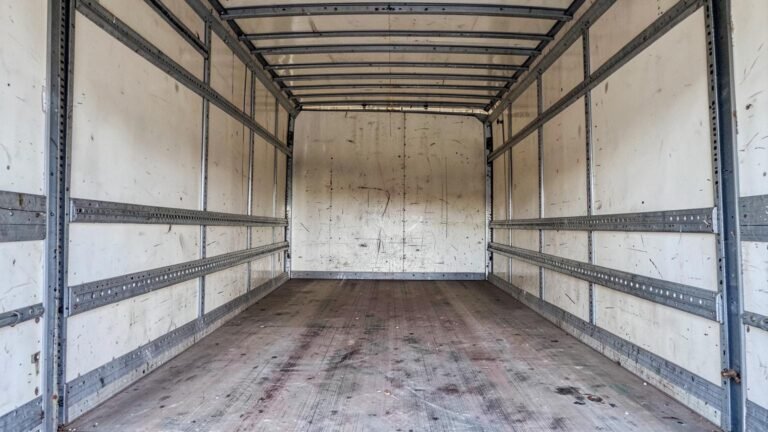
Counts assume you can square pallets up against the walls. In practice a strapped, shrink-wrapped pallet is a few centimetres over its footprint, and a body with wheel arch intrusion loses a position. Treat these as the maximum, not the plan.
Cubic metres
The volume figure is not a box you can fill
Load volume is the number every rental company leads with, and it is the one most likely to mislead you. Multiply our own published figures out and you can see why.
| Vehicle | Quoted load volume | Length × width × height | Difference |
|---|---|---|---|
| Toyota Hiace | 9.8 m³ | 7.9 m³ | 1.9 m³ |
| Nissan Urvan | 9.5 m³ | 8.2 m³ | 1.3 m³ |
| Ford Transit | 11.5 m³ | 10.4 m³ | 1.1 m³ |
| 5-Tonne Truck | 23 m³ | 22.9 m³ | None to speak of |
| 10-Tonne Truck | 43 m³ | 43.2 m³ | None to speak of |
The trucks match almost exactly, because a box body genuinely is a rectangle. The vans do not, and the gap is between one and two cubic metres every time. That space is real — it is the volume over the wheel arches, in the curve of the roof and in the corners behind the rear pillars — but it is not space you can put a box in.
So when you compare a 9.8 m³ van against a 11.5 m³ van, you are comparing two numbers that both include space you cannot use, in different amounts. The length, width and height in the first table are the figures to plan against. Volume is useful for loose loads — sand, bagged waste, a van packed by hand to the roof — and close to useless for anything boxed, palletised or rigid.
Nobody is being dishonest with the volume figures. That is how van load space is conventionally measured, including by the manufacturers. It just answers a different question from the one most people are asking when they read it.
The real limit
Which runs out first, the space or the weight?
Divide the payload by the usable load space and you get the heaviest average load each vehicle can carry per cubic metre. It is a lower number than most people expect, and it explains a lot.
| Vehicle | Usable load space | Payload | Heaviest average load |
|---|---|---|---|
| Toyota Hiace | 7.9 m³ | 1,200 kg | 151 kg per m³ |
| Nissan Urvan | 8.2 m³ | 1,200 kg | 147 kg per m³ |
| Ford Transit | 10.4 m³ | 1,400 kg | 135 kg per m³ |
| 3-Ton Chiller Van | 15.2 m³ | 3,000 kg | 198 kg per m³ |
| 5-Tonne Truck | 22.9 m³ | 5,000 kg | 218 kg per m³ |
| 10-Tonne Truck | 43.2 m³ | 10,000 kg | 231 kg per m³ |
Household furniture and boxed belongings sit at roughly 150 to 200 kg per cubic metre once packed. Compare that against the last column and you can see the problem: on all three panel vans, a properly packed domestic load reaches the payload at about the same moment it reaches the roof. That is not a coincidence, it is how the vehicles are specified, and it is why a van that looks half empty can still be overloaded.
Go denser and the gap opens up fast. Boxed drinks, tinned food, printed paper and tiling all run several times heavier than furniture, and on those the floor stays visible long after the axle is at its limit. A 10-tonne truck carrying tiles is full at perhaps a third of its 43 m³. The same truck carrying bedding, empty crates or insulation will fill to the roof and still be under weight.
None of this is a reason to book bigger by default. It is a reason to tell us what the load actually is rather than how much room you think it needs. Two customers asking for “a van big enough for twenty boxes” get different answers depending on whether the boxes hold cushions or ceramic tiles.
Overloading is not a technicality here. An overloaded vehicle is a fine, and on a rental it is also your responsibility rather than ours — which is exactly why we would rather work it out with you before the vehicle leaves the yard.
The gaps
Three measurements the table cannot give you
Every figure above is a straight line between two walls. These three are the ones that actually stop a load going in, and they are specific to the vehicle rather than the category.
The width between the wheel arches
A van is only its full width above the arches. Down at floor level, where a pallet or a washing machine sits, it is narrower — and that narrower figure is what decides whether two items sit side by side. Ask us and we will measure the van you are booking.
The rear aperture
The doorway is always smaller than the body it opens into. Rear pillars, the door frame and the hinges all eat into it, so something that would sit happily inside can refuse to go through the opening. Anything rigid and close to the full width needs the aperture checked, not the body.
How high the floor sits
A box truck floor is roughly a metre off the ground, which is fine at a loading dock and a real problem on a kerb with two people and a sofa. A panel van floor is low enough to slide things on from standing. None of that appears in a dimensions table and all of it decides how long the job takes.
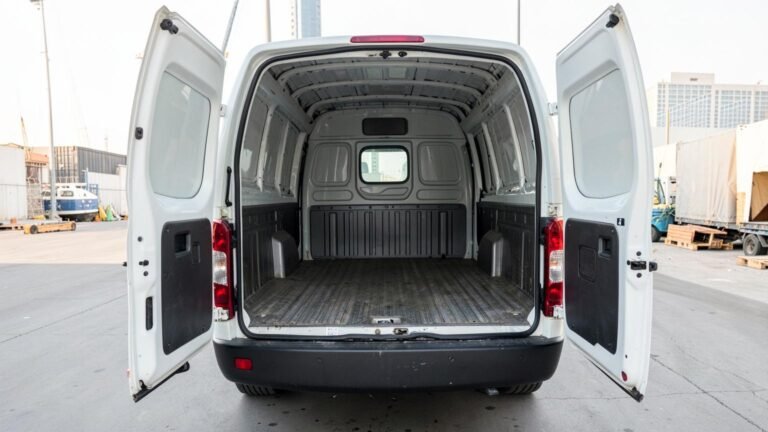
There is a fourth that gets its own guide, because it catches more bookings than the other three combined: the height of the door at the far end. A van that clears every measurement here is still no use if the basement car park at the delivery point has a 2.1 m barrier. That is covered in what high roof really means.
If you are still deciding which size to take rather than checking one you have chosen, start with which van size you actually need — it works from the load rather than from the vehicle.
Questions
Dimension questions we get asked
What are the dimensions of a 3 ton truck?
It depends which 3-tonne vehicle you mean, and that is the root of most of the confusion. Our 3-Ton Chiller Van has a 4.2 m long, 1.9 m wide and 1.9 m high insulated body carrying 3,000 kg. The 3-tonne drop-side pickup carries the same 3,000 kg on an open bed whose length is built to order, so we quote the actual truck. Both carry three tonnes, well past the two tonnes a car licence allows, and that is the licence issue explained in what a 3 ton pickup actually means.
How long is a van in feet?
Our panel vans give 9.8 to 11.2 ft of load length — 3.0 m in the Nissan Urvan, 3.1 m in the Toyota Hiace and 3.4 m in the Ford Transit. Above that you are into truck bodies: 17.1 ft on the 5-tonne and 24.6 ft on the 10-tonne. Those are load floors, not the length of the vehicle on the road.
How many pallets fit in a 5 ton truck?
Eight, on either pallet standard, in a single layer on the 5.2 m floor. The limit you are more likely to hit is weight: eight pallets against 5,000 kg of payload allows 625 kg each, which dense goods pass long before the floor is full.
How many pallets fit in a 3 ton truck?
Six euro pallets or four industrial pallets on the floor of the 4.2 m chiller body. With 3,000 kg of payload that is 500 kg per euro pallet, or 750 kg if you are running the larger footprint.
What is the bed size of a 1 ton pickup?
2.3 m long by 1.5 m wide, which is 7.5 ft by 4.9 ft, with drop sides 0.45 m high. Payload is 1,000 kg. The sides fold down on both flanks and the tail, so it loads from three directions rather than through one opening.
Which vehicle has the longest load space?
The 10-Tonne Truck, at 7.5 m or 24.6 ft, with 2.4 m of width and height. It is the only vehicle we run that takes eighteen euro pallet positions in one layer.
What size is a reefer or chiller truck?
The same body sizes as the dry equivalents, minus the thickness of the insulation, which is already accounted for in the figures above. Our 3-Ton Chiller Van gives 4.2 m, and the 5 and 10-tonne trucks come dry or refrigerated at 5.2 m and 7.5 m. Temperature range rather than size is what usually decides between them — see chiller van versus freezer van.
Can I get these measurements for the exact vehicle before I book?
Yes, and on two of them you should. Insulated conversions and fabricated drop-side beds vary between units, so we measure the one being sent rather than quoting a category figure. Send the dates and the load and the confirmation comes back with the real numbers.
Get it checked
Send the load, not the tonnage
Tell us the biggest item, the pallet count and the weight, and we will tell you which vehicle takes it in one trip — including the measurements of the specific van or truck you would be getting.