
Fleet · Large panel van
Ford Transit rental in Dubai
The biggest panel van we run. 11.5 m³ and a 1,400 kg payload, which is the point where a two-bedroom move stops being two trips and becomes one.
From AED 250 per day
1,400 kg payload
3.4 m load length
Free delivery in Dubai
The Ford Transit is built both as a panel van, with a solid bulkhead and a closed load area behind it, and as a window version with side glazing and extra seating. Every measurement quoted on this page is the panel van — say which body you want when you enquire and we will confirm what is available on your dates.
Photographs
The actual Ford Transit
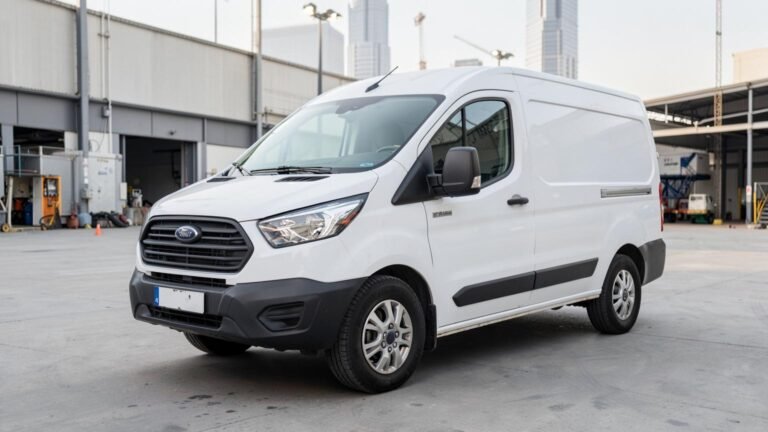
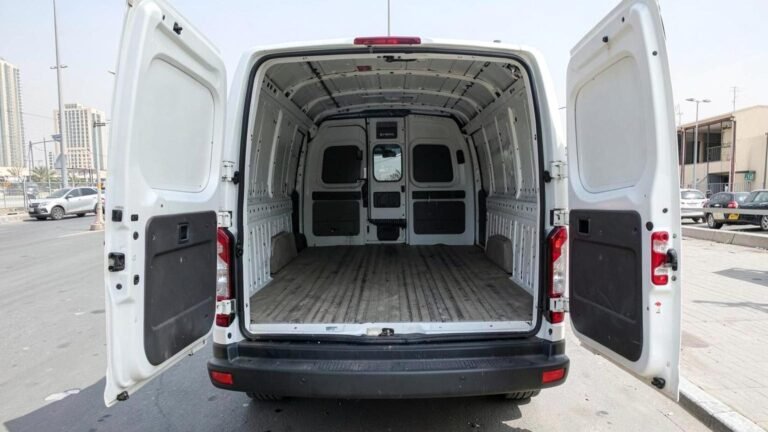
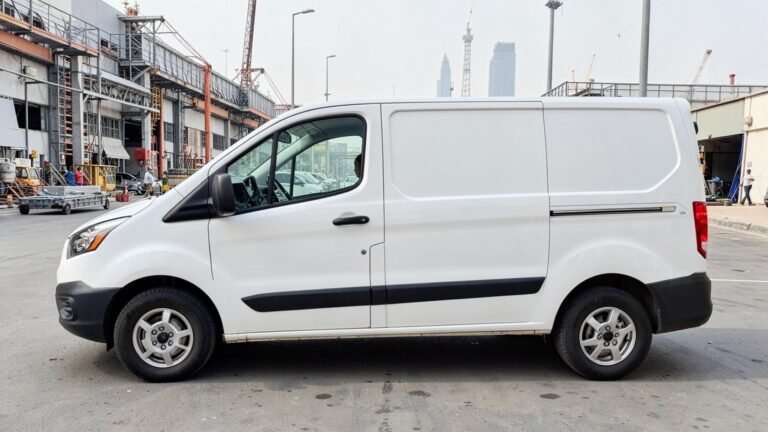
These are our own Transits, taken in the yard between hires rather than lifted from a manufacturer brochure. The picture worth studying is the one with the rear doors open and the bay empty, because on the largest van we run the only question that really decides the booking is whether the longest thing you own will go in with everything else still around it.
Dimensions
Drawn to scale
Taken off the vehicle with a tape rather than copied from a specification sheet. Transit bodies differ between model years by a centimetre or two, so where your longest item comes within about 5 cm of the figure below, send us the measurement and we will check the actual van you would be given before the dates are held.
- 3.4 mload length
- 1.8 mload height
- 1,400 kgpayload
Specification
Will your load fit?
At 3.4 m the load bed takes a three-seat sofa, a wardrobe and a mattress in one go. If you are moving a whole flat, this is usually the cheaper answer once you count the second trip you did not have to make.
| Load volume | 11.5 m³ |
| Load length | 3.4 m |
| Load width | 1.7 m |
| Load height | 1.8 m |
| Payload | 1,400 kg |
| Seats | 3 |
| Engine | 2.2L diesel |
| Transmission | Manual |
| Doors | Rear double doors and side sliding door |
Rates
Ford Transit hire rates
In AED, including comprehensive insurance, registration and maintenance. Fuel, Salik, fines and 5% VAT are charged separately.
| Term | Rate | Mileage included |
|---|---|---|
| Per day | AED 250 | 150 km per day |
| Per week | AED 1,450 | 1,000 km per week |
| Per month | AED 4,200 | 3,500 km per month |
Extra kilometres are charged at AED 0.60 each. See the full rate card for every van.
What people use the Transit for
Full flat and villa moves
Two-bedroom flats and small villas, usually in a single load. Sofa, beds, wardrobes and boxes all travel together.
Fit-out and contracting
Joinery, panels, glass crates and tools between the workshop and site. Long boards go in without hanging out of the back.
Heavier distribution
Pallet-based deliveries and wholesale runs where a Hiace would hit its weight limit before it filled up.
The extra length
What 3.4 metres actually buys you
The Transit is a few tens of centimetres longer than the vans below it. Those centimetres are the whole reason the page exists.
A Hiace gives you 3.1 m of floor and an Urvan 3.0 m. The Transit gives you 3.4 m. That sounds like a rounding error until you put a three-seat sofa on the floor, because a three-seat sofa is usually somewhere around 2.1 to 2.3 m and it has to go in with everything else, not instead of it.
The practical test is what still fits behind the long item. On the shorter vans a sofa leaves you roughly three quarters of a metre before the doors, which is one row of boxes. On the Transit it leaves well over a metre, which is two rows plus the gap you need to close the doors without leaning on them. That is the difference between one trip and two, and it is the only reason to pay the higher day rate.
Long materials behave the same way. Standard timber, conduit and skirting are commonly cut to three metres, and three metres will not go into a 3.0 m body with the doors shut. In a Transit it goes in flat, lies straight, and does not need to be angled across the load bay or left sticking out of the back.
Height comes with it. At 1.8 m inside, the Transit is the tallest dry van we run, and that is what lets a fridge or a full-height wardrobe stand upright next to the rest of the load rather than lying across it. The high-roof guide covers where that ceiling sits across the whole fleet.
Width is the figure nobody checks and the one that stops a load more often than people expect. At 1.7 m between the walls, the Transit takes a standard mattress lying flat with room beside it. Measure your widest item before you assume it drops in.
All of these are internal figures, measured between the walls and behind the closed doors. If your longest item is past 3.4 m the next real step is a 5.2 m box body on the 5-tonne truck, not a different van: there is nothing between the two, and trying to close the gap by angling a long item across the load bay wastes more floor than it gains.
Loading
Getting a two-bedroom flat in on one load
A full flat fits in a Transit, but only if it goes in in the right order. Loaded badly, the same contents will not close the doors.
Start with what must lie flat and full length: the mattress, the sofa on its base, the bed slats. These go in first, along one wall, from the bulkhead back. They set the shape of everything else and they are the items that will not tolerate being squeezed in at the end.
Next the tall rigid things that stand: the wardrobe carcass, the fridge, a bookcase. These go against the opposite wall, upright, strapped to the tie points. Between the two walls you now have a channel, and that channel is where the boxes go, heaviest at the bottom and stacked to about shoulder height before anything lighter goes on top.
Keep the last metre for the awkward leftovers, because there are always leftovers: the lamp, the mirror, the bag of cables, the plant. If you have filled that metre with boxes you will be repacking in the car park. If you have kept it clear, the doors close on the first attempt.
The one rule worth breaking a sweat over is that nothing loose sits above head height at the doors. Everything shifts a little on the drive, and the load you open at the other end is not quite the load you closed.
If any single item is genuinely marginal, measure it and send us the number before the day. We would rather check the actual vehicle than have you discover it with a flat full of furniture on the pavement.
Two people and a trolley will load a full flat in a fraction of the time one person will, and the fragile work happens at the end when everyone is tired. Blankets between hard edges, a strap across each wall of the load, and a walk round the inside before the doors close are worth the five minutes they cost.
Trade use
Why a panel van suits fit-out and site work
Most of our Transit hires are not house moves. They are trades, and the reasons are different ones.
A panel van has no glass behind the cab. Tools, materials and stock are out of sight from the moment the doors shut, which matters on a site where the van spends the day parked among people who are not your crew. A pickup carries the same load and shows it to everybody.
It is also the largest vehicle in our range that an ordinary car licence covers, which is the practical ceiling for a lot of small contractors. Above this you are into three tonnes and upwards, which means a heavier licence or one of our drivers, and a different conversation about who on your team can legally move the vehicle.
Access is the other reason. A Transit goes where a truck does not: community gates, basement levels with an ordinary height barrier, hotel and mall service entrances, and the narrow service roads behind older buildings. On a fit-out that involves repeated small deliveries into an occupied building, the vehicle that can reach the door beats the vehicle that holds more.
And the payload is real. At 1,400 kg it carries a serious weight of tiles, board, fixings or plant, which is usually the thing that separates it from the smaller vans on a site run rather than the volume.
What it will not do is keep anything cold, and it is not the vehicle for a load that needs an open bed and a crane or straps over the top. Those are different vehicles, and we will say so rather than let you book this one.
Longer hires
Weekly, monthly and project hire
A lot of Transit work is not a day. If the job runs for weeks, the shape of the booking should change with it.
The weekly and monthly rates are on the table above, and past roughly a fortnight of separate days in a month the monthly figure is the cheaper way to buy the same vehicle. Comprehensive insurance, registration and maintenance are inside the rate either way, so a long hire does not quietly acquire costs a short one does not have.
Mileage is the figure to watch rather than the rate. A monthly term includes 3,500 km, which is comfortable for a van working inside Dubai and tight for one running out to Abu Dhabi or the Northern Emirates several times a week. If the project involves regular inter-emirate legs, tell us at the quote stage so the allowance is set against the real route instead of being settled in extra kilometres at the end.
For fit-out and contracting work the useful question is how many weeks the van is genuinely needed rather than how many weeks the project runs. Vehicles booked for the whole programme and used for half of it are the most common avoidable cost on a project hire, and a fortnight now with an extension later usually beats three months booked on optimism.
Tell us the site, the start date and roughly how far the van will run in a week. We will put the term and the mileage against that rather than against the standard card.
One practical note on long hires: tell us before the end date if the job is running over, not on the morning it ends. A vehicle already promised to somebody else is the one problem we cannot solve on the day, and a week of notice usually means you keep the same van rather than swapping to whatever is free.
Transit questions
Is a Transit harder to drive than a Hiace?
It is longer and taller, so parking and multi-storey car parks need more thought. On open roads it drives much like a large car. Watch the 1.8 m height at barriers.
Do I still only need a normal licence?
Yes. A standard UAE light vehicle licence covers the Transit — there is no separate category to apply for.
Can I get help loading?
We can arrange a driver, and a driver plus one helper, on request. Tell us how many floors and whether there is a lift, and we will quote it properly.
Other vans in the fleet
Reserve a Transit
Send the dates, the pickup point and a line about the load. We will confirm a Transit is free, say whether it is the right size for what you have described, and list the documents to bring.