
Fleet · Panel van
Nissan Urvan rental in Dubai
The tall one. Same footprint as a Hiace but with more height inside, which makes it the better van for furniture, event equipment and anything you would rather stack than lay flat.
From AED 200 per day
1,200 kg payload
1.7 m internal height
Free delivery in Dubai
The Nissan Urvan is sold as a panel van, with a solid bulkhead and a sealed load area behind it, and as a window version with side glazing and extra seats. Every figure quoted on this page is the panel van — if the windowed one is what you want, say so when you enquire and we will confirm which body style is free on your dates.
Photographs
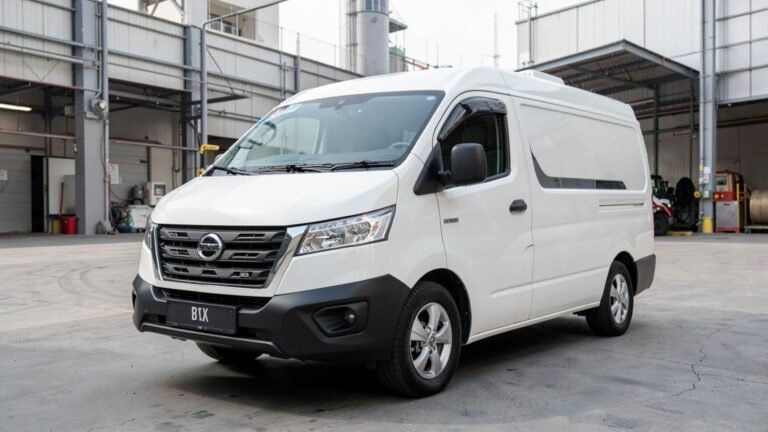
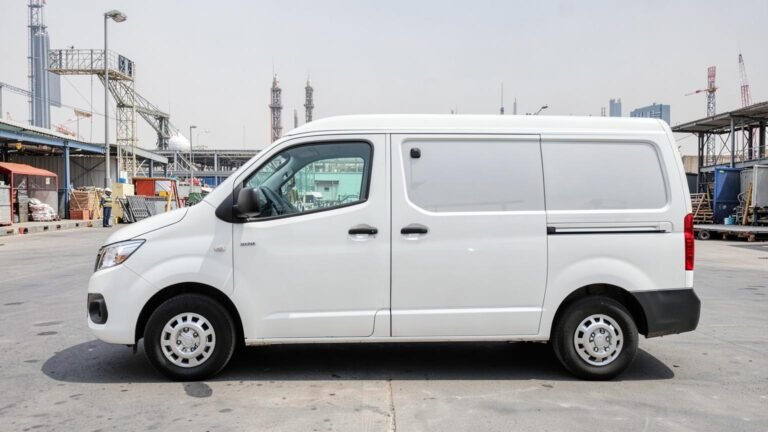
The actual Nissan Urvan
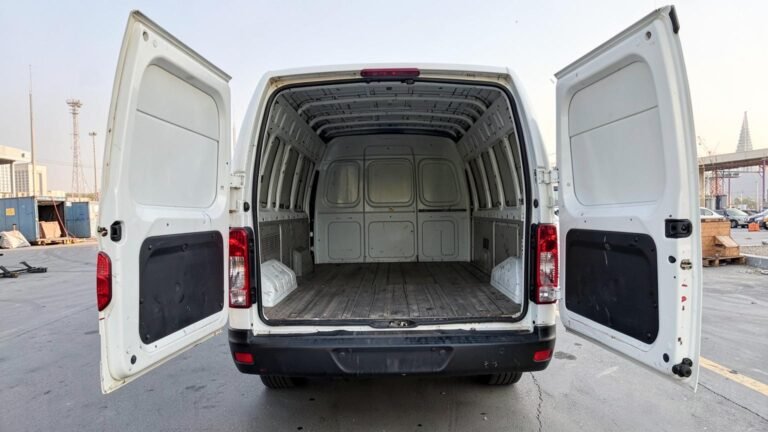
These are our own Urvans, photographed in the yard between hires rather than lifted from a manufacturer brochure. Look hardest at the shot with the rear doors open. On a van people choose for its height, the load bay is the only picture that answers the question they actually came with, which is whether the thing standing in their hallway will stand up in here too.
Dimensions
Drawn to scale
Every number below came off the vehicle with a tape rather than out of a specification sheet. Body styles and model years differ by a centimetre or two, so if your load sits within about 5 cm of any of these figures, send us the measurements and we will check the actual van you would be given before you commit to the dates.
- 3 mload length
- 1.7 mload height
- 1,200 kgpayload
Specification
Will your load fit?
The extra 10 cm of height over a Hiace sounds small but it is the difference between a fridge standing upright and a fridge on its back. Check the numbers, and ask us if it is marginal.
| Load volume | 9.5 m³ |
| Load length | 3.0 m |
| Load width | 1.6 m |
| Load height | 1.7 m |
| Payload | 1,200 kg |
| Seats | 3 |
| Engine | 2.5L petrol |
| Transmission | Manual |
| Doors | Rear double doors and side sliding door |
Rates
Nissan Urvan hire rates
In AED, including comprehensive insurance, registration and maintenance. Fuel, Salik, fines and 5% VAT are charged separately.
| Term | Rate | Mileage included |
|---|---|---|
| Per day | AED 200 | 150 km per day |
| Per week | AED 1,150 | 1,000 km per week |
| Per month | AED 3,300 | 3,500 km per month |
Extra kilometres are charged at AED 0.50 each. See the full rate card for every van.
What people use the Urvan for
Furniture moves
Wardrobes, fridges, bookcases and dining tables that need to travel upright rather than on their side.
Events and exhibitions
Stand panels, staging, AV kit and catering equipment between venues around Dubai World Trade Centre and Expo City.
Bulky, light freight
Packaging, textiles, foam, empty crates — loads that fill a van long before they get anywhere near the weight limit.
Capacity
What 9.5 cubic metres actually holds
Volume is a hard figure to picture. It helps to convert it into the things people actually put in a van.
The load area is 3.0 m long, 1.6 m wide and 1.7 m high. That floor takes four standard pallet footprints with room left over at the rear doors, though there is no tail lift on this van, so pallets either come off a dock at your level or get broken down and carried in by hand. Most of our customers do the second.
In household terms, 9.5 m³ is roughly a studio or small one-bedroom flat in one trip, provided the sofa is not oversized and the beds come apart. In box terms, stacked properly to the roof, it is a few hundred standard removal cartons. In trade terms it is a day of parts, stock or tools with the middle of the floor still clear to walk through.
A quick way to turn an inventory into a van size: count the cartons, add the furniture separately by its three largest pieces, and ignore everything small because it fills the gaps. Forty to fifty cartons plus a bed, a wardrobe and a fridge is an Urvan load. Double that and you are looking at two trips or a bigger vehicle.
The figure assumes you stack. A van loaded in one layer, with gaps between items because nobody wanted to build upwards, uses perhaps half its volume, which is how a 9.5 m³ van fills up with what looks like 4 m³ of goods. The height on this van only pays for itself if you use it.
Remember the cab holds three people including the driver. A move with four adults needs a second car following, and a van packed to the roof leaves nowhere to put the passenger who did not fit. It is a small detail that derails a Saturday more often than the load ever does.
If the load is close to the line, the honest test is to measure the largest three items and add up the rest by carton count rather than by eye. We would rather talk it through before the booking than send the wrong van.
Weight or space
Payload or volume — which one you run out of first
Two limits sit on every van, and which one bites depends entirely on what you are carrying.
The Urvan carries 1,200 kg in 9.5 m³. Divide one by the other and you get about 126 kg per cubic metre, which is the density at which the two limits run out together. Anything heavier than that fills the weight before it fills the space; anything lighter fills the space first.
Dense loads sit well above that line. Tiles, cement, bottled water, paint, batteries, books, paper stock and machinery parts all reach 1,200 kg long before the van looks full, and a van that looks half empty can be over its payload. This is the case where a loaded floor and an empty roof is correct, not wasteful.
Light loads sit far below it. Packaging, foam, textiles, empty crates, display stands and most furniture will fill 9.5 m³ at a fraction of the payload, which is exactly the job this van is shaped for and the reason its height matters more than its weight rating.
Where the weight sits matters as much as how much of it there is. Heavy items belong low and just ahead of the rear axle, which is roughly the middle of the load floor, not at the tail doors. A dense pallet loaded last and left at the back lightens the steering and lengthens the braking distance, and you feel it the first time you need to stop quickly.
For mixed loads the order is heavy and low first, light and bulky on top, nothing loose above head height at the doors. That sequence also happens to be the safest one to unload, because the pieces that can hurt you come off last and at waist height rather than off the top of a stack.
Payload counts everything you put in, including you, your passengers and anything already strapped in the back. If you are near the limit, weigh rather than guess: the penalty for being over falls on the driver, and the van does not stop as well as it did empty.
Loading
Two ways in, and when the side door earns its place
Rear double doors and a full side sliding door are not the same opening, and they suit different jobs.
The rear doors are the ones you load through when you are filling the van properly. They open to the full width of the load area, they let you push long items straight down the middle, and they are the right choice when you are building a stacked load from the bulkhead backwards.
The side door earns its place when you cannot get behind the van. Reversed into a tight bay, parked nose-in on a residential street, or standing at a kerb with traffic behind you, the side door is the only opening you can safely use, and it turns an impossible stop into a two-minute one.
It also changes how you pack for multi-drop work. Load in reverse order of delivery and keep the first few drops within arm’s reach of the side door, and you can work through a run of stops without unloading half the van at each one. Deliveries in older parts of Deira, Karama and Satwa are where this shows most.
Use the tie points rather than wedging. Straps through the floor rings hold a load through a roundabout; a mattress jammed against the doors does not, and it puts the whole load against the catches every time you brake. Blankets between hard edges and painted surfaces cost nothing and save an argument about damage at the end of the hire.
For a single-drop house move, load the room you want to unpack last at the bulkhead and the kitchen boxes at the doors. It sounds fussy in the driveway and it saves half an hour at the other end, when the lift has a queue and you want the first trolley load to be the one you actually need.
One caution: a side door opens into the traffic lane on a right-hand-drive stop and into the pavement on a left. Check which side you are on before you swing it, and never leave it open across a live lane while you look for a doorbell.
Honest steer
When the Urvan is the wrong van
It is a good van for a specific shape of job. These are the cases where we would send you to something else.
If you want an automatic, take the Hiace. Ours are manual, and a manual in stop-start traffic on Sheikh Zayed Road is a long morning for a driver who does not use one daily.
If your tallest item is over 1.7 m, the Transit gives you 1.8 m and more floor with it. If it is well over, the answer is a box body rather than a taller van, and the high-roof guide sets out where each vehicle stops.
If anything you are carrying has to stay cold, no panel van will do it. Chilled and frozen goods need the 3-Ton Chiller Van, which holds −18 °C to +5 °C, and a few hours in a closed metal box in a Dubai summer is enough to ruin a load that was fine when it left.
If you would rather not drive at all, the same van is available with one of our drivers, which also removes the manual gearbox question and the parking one. It suits event days, multi-drop runs and anyone who needs to be doing something other than looking for a loading bay.
And if the need is not a day but a season, look at the monthly rate before booking a run of separate days. Past roughly a fortnight in any month the monthly figure is the cheaper of the two, and it comes with the same insurance, registration and maintenance already included.
And if the load is heavy rather than bulky, or it is a single awkward item that needs an open bed and straps over the top, a pickup or a truck is the better vehicle. Tell us the load rather than the van you had in mind, and we will say which one it is.
Urvan questions
Hiace or Urvan — which should I take?
Take the Urvan if your load is tall, the Hiace if it is long or if you want an automatic. Capacity and payload are close enough that height and gearbox are the real deciders.
Is it manual only?
Our Urvans are manual. If you would rather not drive a manual in Dubai traffic, take the Hiace or book the van with a driver.
Can I load it from the side?
Yes. There is a full side sliding door as well as rear double doors, which helps when you are parked tight to a wall or loading bay.
Other vans in the fleet
Reserve an Urvan
Send the dates, the pickup point and a line about what you are loading. We will confirm whether an Urvan is free, whether it is the right van for that load, and which documents to bring with you.